My electric bill hit $380 the third summer in a row before I finally sat down with a Kill-A-Watt meter and started measuring instead of guessing. Turns out I'd been guessing wrong on almost everything — I sized my first battery bank off numbers I basically pulled out of the air, and the inverter tripped the first week because I didn't account for what a compressor actually pulls when it kicks on, not just when it's cruising along. This chart is the fix: real running and startup wattage, pulled from a generator manufacturer's own spec chart plus a couple of measured-appliance databases, not a blog post that vanishes the week after you bookmark it (three of my old citations here did exactly that, which is its own lesson in not trusting a single source). If you're sizing an inverter, a solar array, or a generator, the starting-watts column matters as much as the running one — sometimes more.
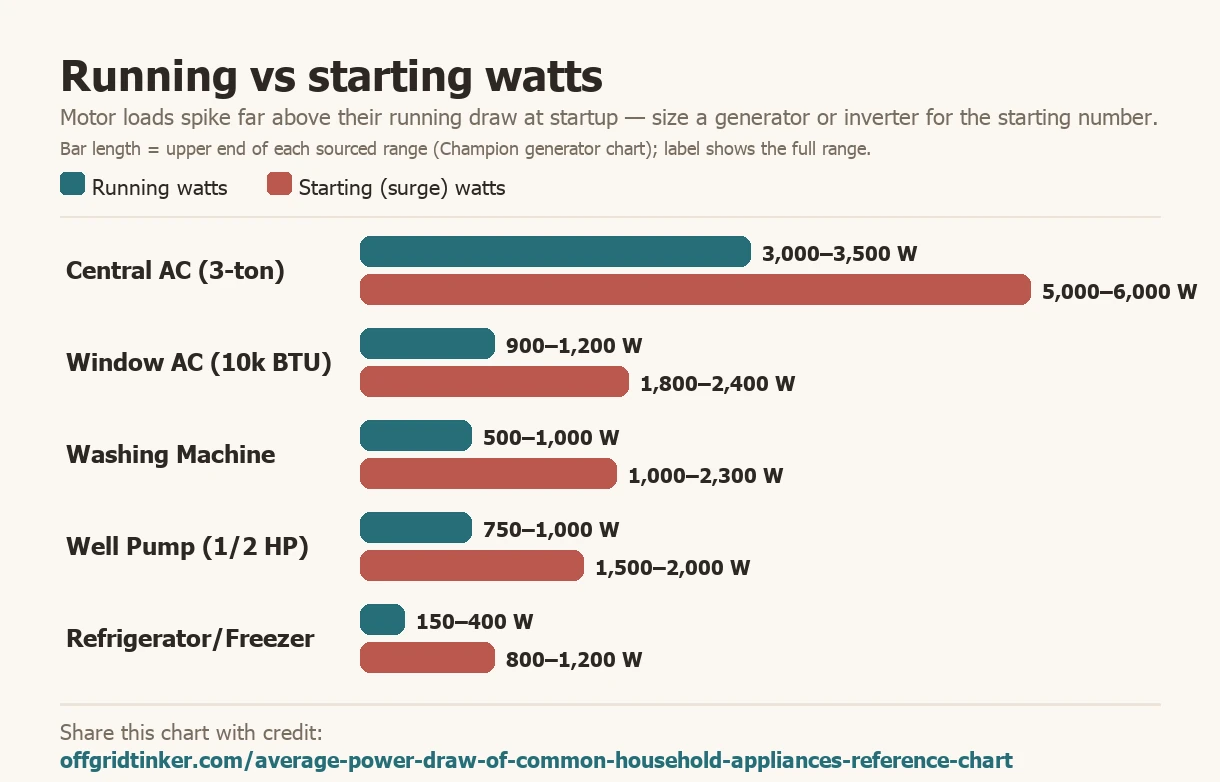
The one rule: size your inverter or generator for the starting watts, not the running ones — a motor load like a well pump or an AC compressor can pull roughly double its running draw for the second it spins up.
Kitchen Appliances
Kitchen loads are where people budget wrong most often, in my experience. You look at a fridge's running wattage and figure you're covered, then forget the compressor cycling back on is basically a mini power spike — kind of like how a hard drive spinning up pulls way more current for a second than it does once it's just idling and serving reads. My old fridge alone would trip a cheap 1200W inverter if the toaster happened to be running when the compressor kicked in. Learned that one the hard way, twice.
| Appliance | Average Running Wattage (W) | Estimated Surge/Starting Wattage (W) |
|---|---|---|
| Refrigerator / Freezer (standard) | 150 – 400 [1] | 800 – 1,200 [1] |
| Microwave Oven | 600 – 1,200 [1] | N/A (source marks this load as needing no extra starting watts) |
| Dishwasher | 1,200 – 2,400 [1] | N/A (source marks this load as needing no extra starting watts) |
| Coffee Maker | 1000 [2] | N/A (resistive heating element) |
| Toaster | 850 [2] | N/A (resistive heating element) |
Laundry and Cleaning
Washers and dryers are motor-and-heating-element loads, and motors are drama queens about startup — they want a lot more than their running number for about a second while the drum gets moving. I found this out running my washer off a battery bank I'd sized for running watts only. Breaker on the inverter popped mid-spin-cycle. My wife was not thrilled about the wet towels.
| Appliance | Average Running Wattage (W) | Estimated Surge/Starting Wattage (W) |
|---|---|---|
| Washing Machine | 500 – 1,000 [1] | 1,000 – 2,300 [1] |
| Clothes Dryer (Electric) | 4,000 – 6,000 [1] | N/A (source marks this load as needing no extra starting watts) |
Climate Control and Water Heating
This is the section that actually matters if you're sizing anything serious for backup or off-grid use. A 3-ton central AC needs close to twice its running wattage just to get the compressor spinning — same idea as your router needing a bigger power brick to boot up than it does once it's just passing traffic. Well pumps are the sneaky one: barely sip power once they're running, but the startup spike is roughly double the running draw. I undersized a generator for a well pump exactly once and I don't plan on doing it again.
| Appliance | Average Running Wattage (W) | Estimated Surge/Starting Wattage (W) |
|---|---|---|
| Central Air Conditioner (3-ton) | 3,000 – 3,500 [1] | 5,000 – 6,000 [1] |
| Window AC Unit (10,000 BTU) | 900 – 1,200 [1] | 1,800 – 2,400 [1] |
| Space Heater (Portable) | 750 – 1,500 [1] | N/A (source marks this load as needing no extra starting watts) |
| Electric Water Heater | 3,000 – 4,500 [1] | N/A (source marks this load as needing no extra starting watts) |
| Well Pump (1/2 HP) | 750 – 1,000 [1] | 1,500 – 2,000 [1] |
Electronics and Home Office
Electronics are the easy part — nothing here has a motor, so nothing surges. What did surprise me is how much screen size and workload swing the numbers: a 65-inch TV pulls noticeably more running power than a 32-inch one, and a desktop under a heavy load can pull more than four times what it pulls at idle. None of these sources agree with each other down to the watt, which tracks with what I've measured myself with the Kill-A-Watt — actual draw depends on the specific unit, its age, and how hard it's working, not just its category.
| Appliance | Average Running Wattage (W) | Standby/Phantom Draw (W) |
|---|---|---|
| Laptop Computer | 50 – 100 [3] | Not measured by source (listed N/A) |
| Desktop Computer | 100 – 450 [3] | Not measured by source (listed N/A) |
| LED Television (32" – 65") | 20 – 130 [3] | 0.3 – 1 [3] |
| Game Console | 120 – 200 [3] | Not measured by source (listed N/A) |
None of this is professional electrical advice — I'm an IT guy with a multimeter, not a licensed electrician, and this page is informational, built from my own testing plus the sources cited below. If you're wiring a transfer switch, tying a backup system into your main panel, or doing anything past plugging something into an outlet, get a licensed electrician to look at it before you flip anything on. The interaction I'd actually worry about here: undersizing an inverter or generator for a compressor or pump's startup surge doesn't just trip a breaker — it can overheat the inverter or the wiring feeding it. And if you're running a backup generator without a transfer switch, backfeeding power into your house wiring can send electricity back down the line and injure or kill a utility lineman working on what they think is a dead circuit. Don't guess on either of those. Size for the starting-watts number, not the running one, and get a professional involved if you're not sure.
Last verified: 2026-07-11