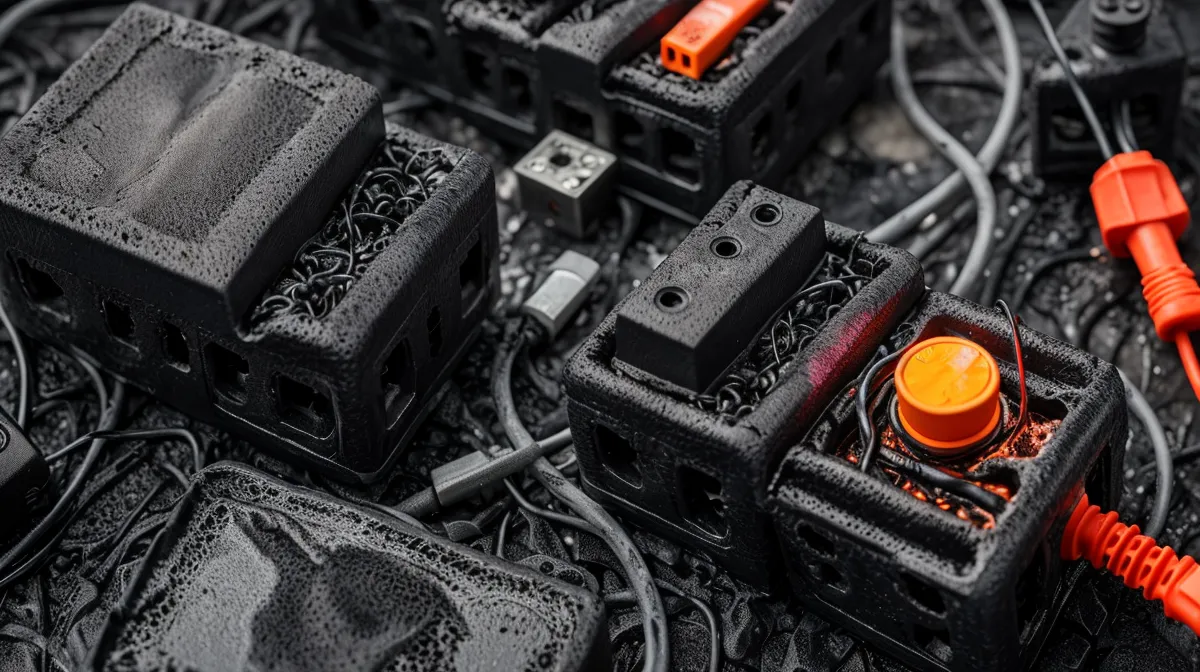
The smell hits before the heat does, a sharp ozone tang cutting through the stagnant air of my garage workshop. My multimeter said the battery bank expansion I'd just wired up was pulling decent power. My nose said otherwise. In IT, that smell in a server room means a hardware failure is minutes away; in a garage full of LiFePO4 batteries and plywood, it means a fire might be five minutes out. I've made five wiring mistakes serious enough to teach me real solar safety the hard way, and this is the DIY wiring rundown I wish someone had handed me before my first off-grid power build.
My first attempt at cutting that bill wasn't even solar. Long before any panel went up, I swapped every bulb in the house for LEDs and watched the number drop a little — on a bill that kept landing at $380 for the third summer running, that's a rounding error, not a fix. A rough home energy audit afterward pointed at air conditioning and the office setup I run most of the day as the real load, not lighting. That's what actually pushed me toward panels and a battery bank instead of another gadget.
None of this makes me a licensed electrician. I'm an IT support tech who thought a few panels and some batteries would be a weekend project, and DC power turned out to be a lot less forgiving than a Cat6 cable. Mess up a network run and the internet drops. Mess up a DC circuit and the drywall can catch. Everything below is what I got wrong, in the order the garage taught me, and you should still call a licensed electrician before any of it touches your main panel.
Mistake One: Treating Amps Like Network Bandwidth
Current isn't bandwidth, but I treated it that way for the first few months. I had two 100-watt panels wired in parallel — about 200 watts total, which at 12 volts works out to roughly 16.6 amps. Voltage drop is brutal at that pressure. Industry practice caps acceptable drop at 3 percent of system voltage across any given run, and I blew past that without ever checking. Watching the ammeter needle creep upward as a panel swings into full noon sun is still the one part of this hobby that feels like magic instead of homework — which is exactly why I wasn't paying attention to the wire underneath it.
Being cheap and impatient, I raided an old cable bin and ran 18-gauge speaker wire between the panels and the controller, on the logic that copper is copper. Eighteen-gauge is rated for around 7 amps over any real distance, and I was pushing more than double that. Over a 25-foot run I measured a drop close to 12 percent, which in a 12-volt system is enormous. That lost energy doesn't vanish. It turns into heat.
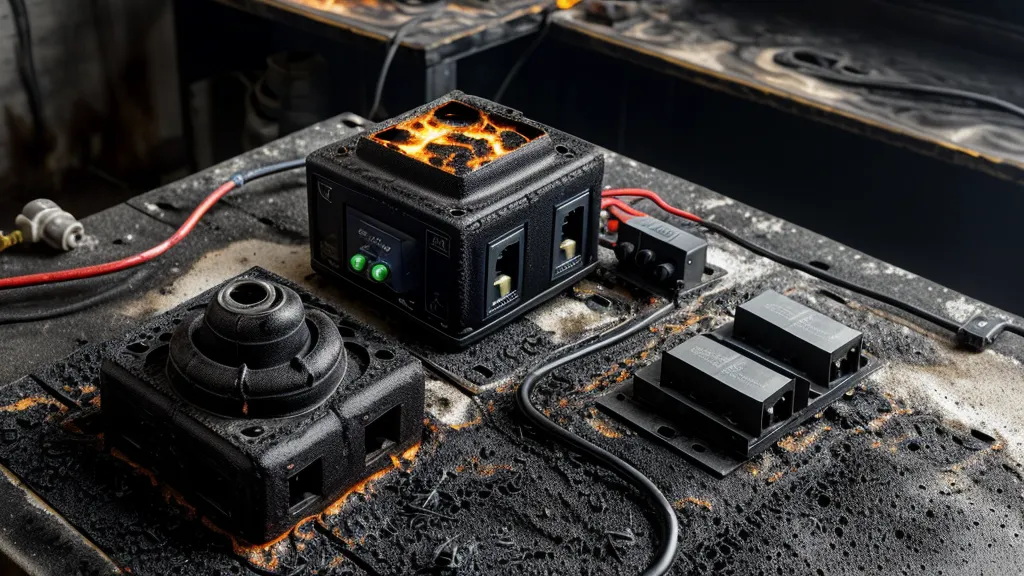
That heat turned the insulation on that speaker wire into a black, gooey mess before I managed to pull the plug. The copper underneath had gone a dull, sickly purple, brittle enough to snap. Now I follow the gauge charts I laid out in my Simple DC Circuit Wiring: A Suburban Dad's Guide — bandwidth thinking doesn't get you out of a physical fire hazard, no matter how clever the workaround sounds.
Why Cranking a Terminal Tighter Makes It Worse
Years of tightening rack screws and case bolts taught me one lesson: tighter is safer. So I cranked every terminal lug down with a long screwdriver until it wouldn't budge another millimeter, figuring I was building a solid connection. I was actually building a hotspot.
Over-torque crushes the individual strands inside a lug and stresses the metal around it, and a crushed strand has less surface area touching the connector — which means more resistance, and resistance shows up as heat. It's the same idea as kinking a garden hose: force the flow through a narrower path and the pressure has to go somewhere.
Warm terminal lugs, with no load running at all, gave the problem away. I'd deformed the copper enough to shrink the contact area, and a torque screwdriver fixed it — it feels almost too loose next to my old method, but the resistance numbers dropped once I stopped overdoing it. If you're sizing a bank in the first place, my DIY Battery Bank Guide 2026 covers sizing for Phoenix heat, and getting that number right upfront saves you a lot of these connection headaches later.
The DC Arc That Won't Put Itself Out
AC is polite. It reverses direction sixty times a second, crossing a zero point where the voltage briefly disappears, and an arc that starts there usually snuffs out on its own. DC has no zero crossing. It's a constant push of electrons with nowhere to rest.
Pulling a live lead off a 12-volt bank is how I found that out. A small spark jumped and didn't disappear — it turned into a persistent blue hiss that just sat there. DC arcs don't self-extinguish. They'll keep burning through a terminal block or plastic housing until the circuit breaks or something ignites, which is why solar setups run heavier switchgear than a typical household circuit. It's not overkill. It's the only thing standing between a small mistake and an unattended welding torch in your garage.
Tariq — a former HVAC tech I met at a home-improvement expo who's building his own off-grid setup — wires his array in series rather than my parallel layout, which pushes his string voltage a lot higher. He told me flatly he'd rather rip out an entire run and start over than leave one questionable joint in it. At series voltage, a wiring mistake isn't just less efficient the way it would be in a parallel string — it's more dangerous, and an arc like the one I described gets worse, not better.
What My IT Instincts Got Wrong About Heat
In a server room, a loose cable shows up as a red link light. In a garage, a loose cable shows up as a terminal block that's turned red — literally, from heat — and I had to retrain myself to read that signal. Signal integrity on a power circuit means temperature, not packets.
Vince — a coworker from the IT department who overheard me griping about that $380 bill — lent me his handheld thermal camera along with a clamp meter, and made a point of telling me a real current sensor would catch things mine couldn't. He's never built anything with his hands, but he's never short on a sharper way to test something, and this time he wasn't wrong. Seeing a terminal glow yellow on a screen before the garage smells like ozone changed how early I catch these problems now.
Thermal Cycling Is the Desert's Favorite Trick
January delivered the next lesson. I'd bridged the panels to the charge controller with a cheap plastic terminal block and hadn't checked it in weeks. Even in a Phoenix winter my garage swings close to 40 degrees between morning and afternoon, and that constant heating and cooling — thermal cycling, in IT hardware terms — is enough to walk a screw terminal loose over time.
A loose terminal opens an air gap. An air gap arcs. An arc makes heat, and heat was exactly what I found: the plastic housing on that charge controller had started bubbling, melted into a charred mess around the terminal. That controller ran plain PWM regulation — the PWM-versus-MPPT debate is a separate rabbit hole about efficiency, not the one that mattered that night. I stood there with a headlamp trying to work out how to explain the smell to my wife for the second time.
This exact trade-off came up again around the time I was weighing whether a DIY wind turbine or a solar panel actually drops your bill more in the suburbs — wind rigs have their own wiring headaches, like dump loads that run hot enough to worry about. I replaced the whole terminal block with a solid copper busbar and used a non-conducting thread locker on the fasteners so vibration couldn't walk them loose again.
Fuses Are the Firewall Your Garage Workshop Needs
IT systems get redundancy — a power supply fails, a secondary kicks in. In solar wiring, redundancy is a fuse, and without one, the wire itself becomes the fuse, which means it melts. I figured a 12-volt system was low-stakes enough to skip worrying about the National Electrical Code. That was wrong on a specific, quantifiable level: NEC 690.8 requires overcurrent protection for any continuous DC load to be rated at 125 percent of the maximum continuous current draw, and I had none.
Wire a 10-gauge run down to a 14-gauge feed for a small LED light, and if that light shorts, the thin wire catches fire before a main breaker even registers a problem. I had three circuits tied to one battery bank with no individual fuses — a network with no firewall between segments. One short in an experimental rig could have dumped the bank's full amperage into the thinnest wire in the circuit. I rebuilt the whole thing with proper busbars and a dedicated fuse block sized to that 125 percent rule, and it's the cheapest insurance I've bought for that garage.
Two other rabbit holes come up a lot in questions I get and neither one belongs in this list: pure sine versus modified sine inverters, which is a power-quality question for your electronics, and panel tilt angle, which changes your output, not whether your garage catches fire. Wiring safety is its own category, and it's the one most DIY guides skip past on the way to the good parts.
Six Weeks Later: What the Rebuild Taught Me
By week six of the rebuild, the difference showed up as a number, not a feeling. My whole desktop workstation — tower, monitor, everything — pulled a steady 340 watts off the Kill-A-Watt, running entirely on power the panels had banked the day before, without pulling a single watt from the street. That's the kind of result cranking a bolt down harder never gets you.
Out went the speaker wire, the over-torqued lugs, and anything not rated for the load, replaced with properly sized AWG cable. The garage still looks like a Radio Shack exploded in it. It's just a safer Radio Shack now.
If you take one thing from all five mistakes, make it this: your IT background, or whatever expertise got you into this garage in the first place, doesn't substitute for calculating the actual amperage on the actual wire in front of you. Check the gauge chart before you buy the spool. Torque the lug to spec, not to your idea of secure. And call a licensed electrician before any of this touches your home's main panel — your $380 bill and the fix for it aren't worth a fire truck in the driveway.