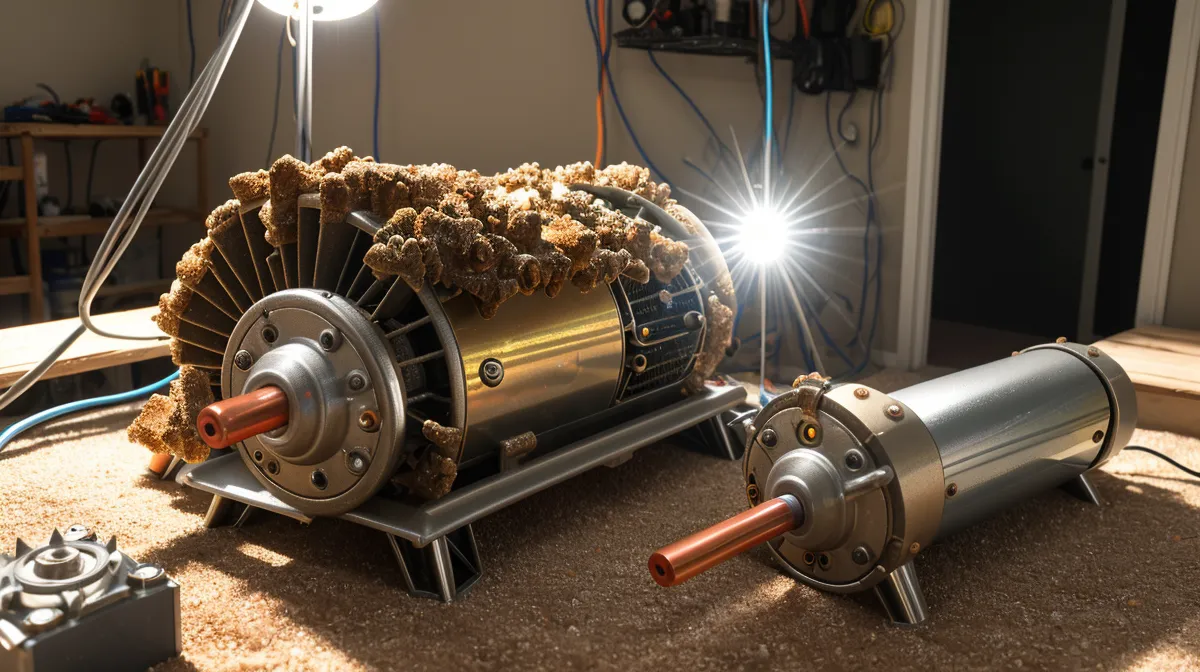
A thirty-layer accumulator built from steel wool and cotton batting does not turn a rotor. A hundred-watt solar panel wired to a charge controller does — it spins a fan, tops off a battery, and hands you a number on a multimeter you can trust every single time. I've built both kinds of projects in the same two-car garage workshop, chasing the same goal, a summer power bill that once sat at $380, and only one of those DIY energy builds survived contact with a meter. This is the orgone motor setup guide, addressing the alignment the etheric power crowd insists you need to nail, and I'm not going to pretend the rotor turned just because I wanted it to.
So What Is an Orgone Motor Supposed to Do?
Wilhelm Reich described orgone as a primordial energy saturating the atmosphere, something an accumulator could concentrate the way a dish concentrates a weak signal. Wilhelm Reich built his case in the 1940s and 50s, and mainstream physics never found anything to measure — no field, no particle, no signature that shows up on instruments built for the job. That matters for a setup guide, because alignment only means something if there's a real force to align with. Treat this as a build log for a folk-physics device, not confirmation that the physics behind it holds up.
The eBay lesson came first, actually, and it's the reason two years into chasing DIY energy fixes, I still go into any "free energy" build expecting disappointment. A seller listed a perpetual magnetic generator kit, and what showed up was a padded envelope of mismatched ferrite blocks that didn't match the included wiring diagram at all. That build never even reached the testing stage. The orgone motor at least reaches testing, which is more than I can say for a few other ideas I've given up on entirely.
Building the Accumulator Without Buying the Hype
Thirty layers means fifteen alternating pairs — organic material against inorganic, cotton batting against fine steel wool, packed into an acrylic housing. The instructions online are oddly specific about the layering order and vague about why it matters, which is its own kind of red flag if you've ever read a real datasheet. I didn't spend much on materials, nothing that dented the budget the way a real battery bank would, but the time investment was real, and so was the mess. Steel wool dust gets into everything, and cleanup took longer than the actual layering.
I did crack the acrylic housing once, from overtightening a screw during final assembly, which meant a full teardown, since any air gap in the housing is supposed to ruin the concentration of the field. Whether or not that concentration exists, a cracked housing is still a cracked housing, and I started over with a lighter touch on the screwdriver.
The 0.5-Millimeter Gap and a Sloped Garage Floor
Point-five millimeters is the tolerance the build community swears by for the gap between the rotor edge and the accumulator plate — anything wider and the rotor supposedly just sits there. I burned through a stack of nylon shims getting that gap dialed in, and the rotor rewarded me with a twitch, never a full rotation. An earlier orgone motor test I ran in this same garage hit the same wall, which told me the gap wasn't the only variable in play.
Rosario, my neighbor from two doors down, wandered over while I had a laser pointer bounced off a mirror on the rotor shaft, checking whether the garage floor's drainage slope was throwing the whole rig off level. Her first question wasn't about the science. It was how many kilowatt-hours the thing was actually making, because that's the only number she tracks on her own 200-watt balcony setup. It's a fair question, and one the orgone motor never answered with anything better than a shrug.
The Multimeter Doesn't Lie, Even When You Want It To
Here's what the multimeter actually recorded once the gap and the level were both dialed in as tight as I could get them: a rotor spinning at a steady 42 RPM under the right push, and a peak reading of 1.4 volts that came and went instead of holding steady. That reading is far more consistent with static buildup and friction between the layers than with any new form of energy, the kind of noise you'd write off instantly if a network monitoring dashboard threw a similar spike.
Forty-two RPM and 1.4 volts is not a power source.
Obinna, who I know from the maker space in Mesa and who reads a component's full datasheet before he'll even pick up a screwdriver, asked me once why I bothered testing something with no real spec sheet behind it at all. I didn't have a great answer beyond curiosity and a stubborn refusal to take the forums' word for it without my own numbers.
Choosing Between the Accumulator and the Charge Controller
Compare that to Obinna's hundred-watt panel at the maker space, wired with proper fusing and grounding after the kind of wiring mistakes that show up on solar builds more often than anyone likes to admit. A panel like that forces real decisions instead of faith. You pick a PWM or an MPPT charge controller to match your panel's voltage, wire the array in series or parallel depending on your battery bank, size that battery bank for what you actually draw after dark, check the inverter's sine wave type before plugging in anything sensitive, and adjust the tilt angle for a Phoenix roof instead of guessing at it. Even a basic home energy audit tells you more about where your money leaks out than a season spent stacking steel wool ever will.
I checked the APS account online later that summer and the total read noticeably lower than it had been sitting, and I refreshed the page twice, half expecting the number to bounce back to something worse. Nothing about the accumulator in the corner of the garage had anything to do with that number. The solar wiring did, along with a few smaller adjustments elsewhere in the house.
So here's the actual choice, laid out plainly: build the orgone motor if you want a weekend that teaches you real patience with tolerances, shimming, and leveling, and you're fine with a multimeter reading that never quite adds up to anything usable. Build the solar setup, or expand one you already have, if you want a project where the numbers agree with you on the first afternoon and every afternoon after that. I keep both in the garage. Only one of them keeps the lights on.