Twelve-gauge copper wire feels warm under a full afternoon load — not hot, just warm — and it took an embarrassingly long time before I stopped treating that warmth as an emergency instead of a design spec. That's the kind of detail nobody mentions when they talk about DIY solar, off-grid living, or the broader promise of energy independence: most of the real learning happens in the small physical facts, not the big-picture math. I'm the guy running extension cords instead of trail runs in a Phoenix subdivision garage, writing this for other Phoenix homeowners.
Quick disclosure before we get into wiring: some of the links below are affiliate links, and if you buy through them I earn a small commission at no extra cost to you. Everything recommended here is something I've built, tested, or watched fail in this actual garage — not a licensed electrician or engineer, just someone with a multimeter and a stubborn streak, so treat anything electrical as a starting point for your own research, not a substitute for a professional.
What My Garage Actually Proved About Off-Grid Living in Phoenix
Readers ask me some version of the same question constantly: does any of this DIY energy stuff actually work, or is it a hobby that happens to produce a blog post? The honest answer splits down the middle. Some of it works well enough to matter on a bill; some of it wastes a Saturday and a trip to the hardware store. Off-grid living, at least the partial version most of us attempt in a suburban tract home, is less a single system and more a stack of small decisions — how much you store, how you convert it, how you protect the wiring — that either work together or fight each other.
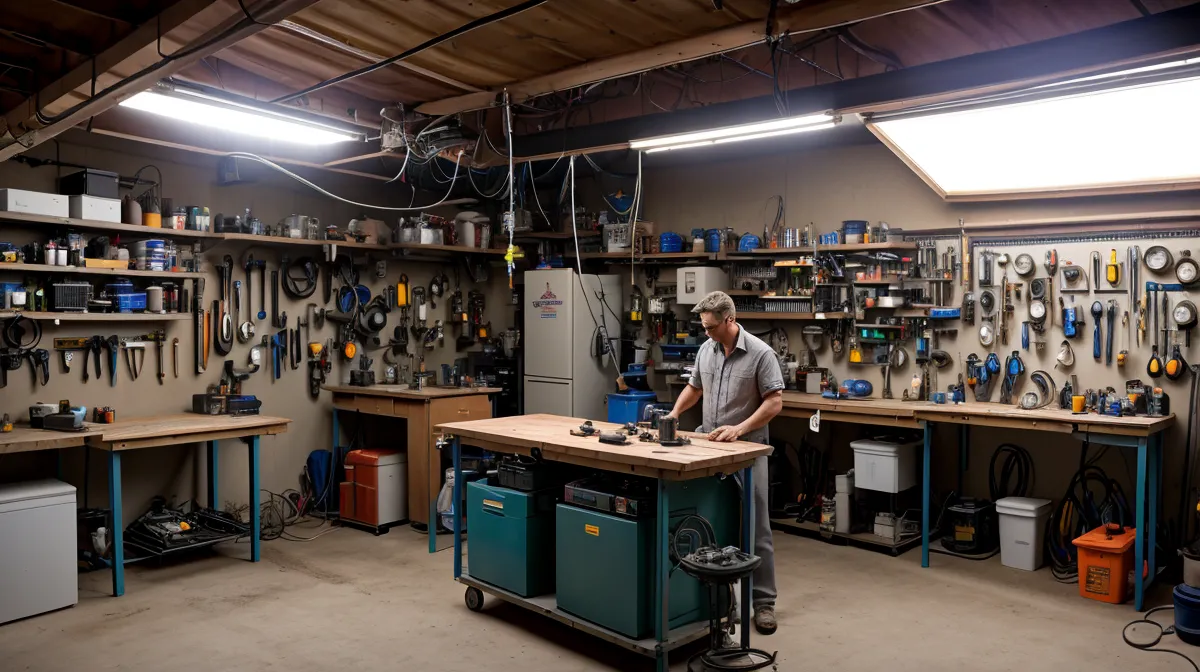
One whole bay of the garage has turned into something between a workshop and a server closet: pegboard covering the wall, cable bundles zip-tied into labeled clusters the way you'd dress patch cables in a rack, and a metal shelf stocked with bins of ring terminals, Anderson connectors, spare fuses, and enough wire to reach the mailbox twice over. A folding workbench holds a clamp-on multimeter and a yellow legal pad gone soft at the edges from a year of scribbled readings, and a box fan grinds away in the corner from May through September because the garage door stays shut and Phoenix does not care about your hobby's comfort. There's a specific scorched-sugar smell that comes off a ring terminal the second you crimp it under a hot iron, my wife calls it the smell of a decision happening in real time, and she isn't often wrong.
The Portable Power Station That Didn't Survive Midnight
Before I built anything myself, I tried the easy way out: a briefcase-sized portable power station, the off-the-shelf kind advertised everywhere as a no-assembly answer to blackouts and blown circuits. The pitch was that it would keep the chest freezer in the garage running through an outage without any wiring at all. It didn't. The freezer's compressor cycle drained the unit faster than the spec sheet implied, and by the time I checked on it the display had gone dark well before midnight, freezer contents well on their way to room temperature. That single failure is what pushed me toward building something instead of buying it, not because building is cheaper, necessarily, but because I could actually see what was drawing power and where the storage margin was disappearing.
The Blueprint That Replaced the Magnets
A magnetic generator kit was the first thing I tried after the portable power station disappointed me, and it promised free energy while delivering exactly none, which surprised nobody, including me. A small wind turbine came next and moved less air than the box fan it stood next to. What actually changed things was finding the Energy Revolution System, which reads more like a real electrical build guide than a science-fair project, parts lists, sequencing, and enough explanation of why each step matters that I could catch my own mistakes before they became sparks. Working through the simple DC circuit wiring basics first made everything after it click faster, the same way understanding basic network topology makes troubleshooting a home router less of a guessing game.
Net Positive, According to My Phone
My phone is what told me the math had finally turned, not a feeling or a lower bill (and definitely not a phone call to the power company). The notification just stacked two numbers on top of each other: 1.4 kWh generated against 1.1 consumed, net positive, for the first time, on an ordinary afternoon with nothing unusual happening outside. I stared at that number longer than it probably deserved. It wasn't a huge margin, and it wouldn't hold through a string of triple-digit days with every AC compressor on the block fighting for the same grid capacity, but it was the first time the direction was right without me squinting at decimal points to make it feel that way.
That screenshot went straight to Kwame Asante, an online contact who turned into an actual friend after enough back-and-forth about charge controller wiring, and his reply was typically him: nice, now show me the load profile for the whole week, not just one lucky afternoon. He's right more often than I'd like to admit, which is the reason I now log every reading on that yellow notepad instead of trusting memory.
Do You Need Backup Power for a Home Office Setup?
High-draw home office equipment changes the backup-power question entirely, and it's the question readers send me more than almost any other. A laptop and a router can coast for hours on a small battery bank; a full workstation running multiple monitors pulls in a different league entirely, and if you size things the way most beginner guides suggest, for a phone charger and a lamp, that gap catches people off guard fast. My own setup leans on the Energy Revolution build for the core system and adds a Power Grid Generator unit as a second, independent source rather than a backup that shares the same failure points as the primary build. The specifics of pairing that with a demanding home office setup are detailed in a separate write-up, since the load profile of a multi-monitor workstation is genuinely different from what most guides assume you're running.
What Readers Ask Me About Battery Banks
The most detailed reader question I've ever gotten came from someone named Juniper Halloway, who emailed after her own 12-volt battery bank kept tripping the breaker every time she tried to pull any real load. She'd already sent labeled photos of every connection before I even asked, the kind of documentation most people don't bother with, and that made the diagnosis almost easy: the interconnect wire between her batteries was undersized for the current she was asking it to carry.
Sizing a battery bank correctly is its own rabbit hole - it's a lot like planning storage on a phone, where you can technically survive on the minimum, but the shortfall shows up within a day of real use rather than a month down the line. Undersized interconnects, like the one in Juniper's build, are still the single most common reason a bank looks fine on paper and trips constantly once it's asked to do real work.
Charge Controllers, Wiring, and Inverters: What to Weigh Before You Buy
Before you buy anything, weigh three decisions that quietly determine whether a small DIY setup performs or disappoints: whether your charge controller is a PWM or an MPPT type, since that choice changes how much of your panel's output you actually get to keep; whether your panels are wired in series or in parallel, which changes both your voltage and how a single shaded panel drags down the rest of the array; and whether your inverter puts out a pure sine wave or a modified one, which matters a lot if you're running anything with a motor or a sensitive charger and matters much less if you're just charging a phone.
Keeping Score: What the Home Energy Management System Told Me
Keeping score is the whole game, and that's really what a home energy management system is for, a way to see which circuits are actually pulling the load instead of guessing. Before you build anything, though, it's worth doing a plain home energy audit first, walking the house circuit by circuit the way you'd document a network before redesigning it, because the cheapest kilowatt-hour is still the one you stop wasting before you ever touch a solar panel.
Is DIY Energy Independence Worth It for Phoenix Homeowners?
So, is it worth it? For a Phoenix homeowner willing to treat a power setup as an ongoing project rather than a one-time purchase, the honest answer is yes, with real caveats attached. The bill relief is real: my own summer number came down by about $120 a month during peak season, which matters against a $380 baseline, and the build has already earned back roughly half of what it cost to put together, largely by following the Energy Revolution System blueprint instead of improvising from forum threads.
None of that happened on the first attempt, and none of it happened without a plan that treated the problem like a real electrical project instead of a shortcut. If you want the specific starting point, that's still the Energy Revolution System - it comes with a 60-day return window if the build isn't for you, which took some of the risk out of committing to a full system instead of another gadget. And if the Phoenix summer heat is already on your mind the way it's on mine every June, it's worth reading through my notes on adjusting your solar panel tilt, since a few degrees of angle change more than people expect once the sun sits that high and that direct.