14.1 volts, held steady on a battery bank multimeter, is the only number six months of alternative-energy tinkering in my Phoenix garage ever produced that I'd defend without flinching. It didn't come from an orgone motor. The grid meter outside hadn't moved; whatever that voltage was, my own gear made it. That's why this piece is a comparison instead of another build log: three failed orgone motor attempts forced me to weigh speculative DIY power experiments against the slower, provable kind. Most of that testing happened through a brutal Phoenix summer that doesn't forgive sloppy wiring or bad assumptions.
Quick disclosure before the technical stuff: this site runs on affiliate links, including a couple of energy-system guides mentioned later on, and I earn a small commission if you buy through them at no extra cost to you. I'm an IT support tech with a soldering iron and too much curiosity, not an electrician or an engineer, so nothing here replaces a licensed professional before you touch a service panel.
Two Roads Out of a $380 Electric Bill
Every alternative-energy rabbit hole I've gone down traces back to the same number: a summer electric bill that hit $380 for the third year running. Two paths kept showing up whenever I searched for a way around it. One was the well-documented, faintly boring route: batteries, panels, charge controllers, inverters, the stuff electricians actually understand. The other was a family of gadgets that promise to pull "free" or "ambient" energy out of geometry and coil windings, no grid connection required. The orgone motor sits firmly in the second category, and my first three attempts at building one are why I can now tell you, with some confidence, which category deserves your garage time.
Why Did an IT Guy Even Try an Orgone Motor?
In my day job troubleshooting network topologies, a dead connection almost always traces back to something concrete: a bad cable, a misconfigured gateway, a failed switch. I assumed alternative energy would work the same way, so when I found a build based on Wilhelm Reich's old theories about a background "life energy," the idea of the orgone motor felt like something I could wind together out of copper and stubbornness instead of buying my way to savings with a full panel array.
This wasn't even my first brush with a "free energy" claim. A while before the orgone motor, I'd ordered what a listing called a perpetual magnetic generator kit from an eBay seller with grainy photos and a description written entirely in vague promises. What showed up was a sandwich bag of mismatched ferrite blocks that didn't match the included diagram in size, shape, or apparently physics. I should have taken that as a warning. Instead I filed it under "bad seller" and kept looking, which is how a guy who fixes Wi-Fi for a living ended up hand-winding copper coils in the middle of summer.
Build One: Mass Without a Thermal Budget
Build one leaned on heavy-gauge wire and a housing scavenged from an old server rack, on the theory that more material meant more output. It's the DIY equivalent of running a five-line batch script on a liquid-cooled gaming rig, overbuilt in a way that just adds failure points. Winding 24 AWG copper around the core took most of an afternoon, and I never once factored in what Phoenix living does to plastic housings left in a hot garage. Hardware stores near Tempe Marketplace, off Priest Drive, sold out of the exact gauge I needed twice before I had enough wound.
The motor didn't spin. It just sat there getting hotter, a very effective way to turn a workbench into a hot plate. Without a real blueprint, I'd built a space heater with delusions of grandeur. The rotor housing warped in the heat and eventually melted straight into the coil, which settled the mass-equals-output theory for good. Somewhere under a pile of scrap copper that evening, I made peace with paying the utility company on time that month.
Build Two: Precision the Salvage Bin Couldn't Give Me
By the time the weather cooled off enough to work without soaking through a shirt, I'd switched strategies: lighter design, smaller capacitor bank, three days spent trying to balance the rotor by feel. Reading up on Simple DC Circuit Wiring helped me understand what I was actually doing wrong at the capacitor stage, even if it didn't save build two in time.
When I flipped the switch, something finally happened. Just not power. The whole assembly vibrated hard enough to walk itself off the workbench, sounding like a blender full of gravel, and a fried capacitor left an ozone smell hanging in the garage for three days. Every IT tech recognizes that smell from a power supply popping in a server room; in your own garage, it just smells like money you're not getting back. The lesson wasn't really about orgone theory, it was that salvaged parts and hand tools demand more precision than factory kits, not less, because nothing about scrap is uniform.
Build Three: Right Parts, Wrong Direction
Fresh diodes, a new multimeter, and four hours of soldering a bridge rectifier at the folding workbench with the notepad open next to the clamp meter the way it always is when I'm tracking readings, build three was supposed to be the stable release. The joints looked clean and professional. I powered it up and got nothing: no vibration, no heat, just a faint hum that felt like it was mocking me personally.
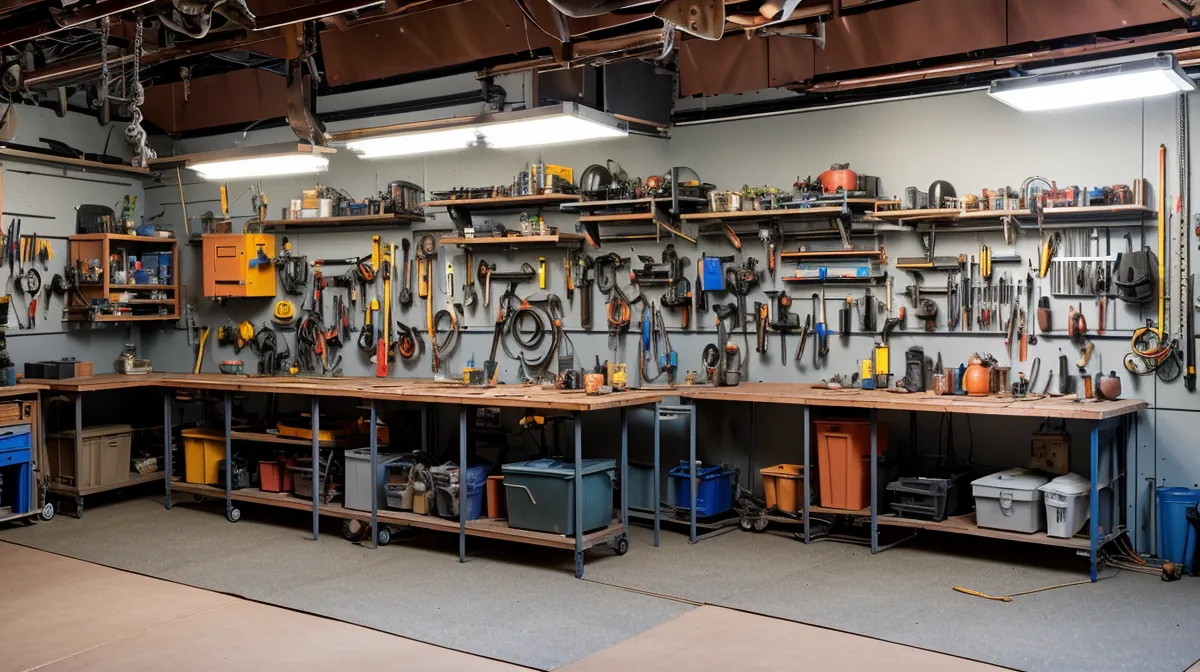
Two hours of troubleshooting later, I found the rookie mistake: every single diode was installed backward. It was the electrical version of a firewall rule that blocks all inbound and outbound traffic at once, a total lockdown with nothing moving in either direction. My wife found me sitting on an overturned bucket with my head in my hands and asked, arms crossed, if the "science experiment" was why the garage door opener had stopped working. It was the garage door opener's dead remote battery instead. But her expression made it clear my garage lab time had a shrinking budget. By then my side of the garage bay had gone full workshop, one whole pegboard wall zip-tied into labeled cable bundles, a metal shelf of bins sorted by ring terminals, Anderson connectors, fuses, and spare wire, a box fan running full-tilt in the corner since the heat set in. It looked less like a renewable-energy lab and more like a surplus electronics store that had taken over a two-car garage.
A Battery Bank Finally Gave Me a Number I Trusted
The 14.1-volt reading that opened this piece came later, from a small battery bank I put together mostly to have something in the garage that actually worked. There was no theory to defend, no geometry to get right, no faith required, just a charge controller, a bank sized for what I was actually running, and a reading that matched what basic electrical math said it should be. That's the real difference between the two paths: one produces a number you can check against a formula, and the other produces a number you have to take on faith.
The Real DIY Power Comparison Isn't Close Once You Measure It
None of this makes the legitimate route effortless. Sizing a bank for what you actually run, choosing between a PWM and an MPPT charge controller, wiring panels in series versus parallel, picking a pure sine wave inverter over a modified one, and setting your panel tilt angle for a Phoenix summer are all real energy efficiency decisions, and I got at least one of them wrong the first time through. But every one of those decisions can be checked against a spec sheet or a multimeter reading. An orgone motor gives you nothing to check against: no spec, no formula, just a claim about ambient energy that either spins or it doesn't.
A guy at the Mesa maker space, Obinna Nwachukwu, is working through a shed-mounted array right now, and he has a habit of asking things in precise electrical terms, source impedance, expected ripple, that kind of language, that makes me tighten up my own explanations before I open my mouth. When I told him about the orgone motor phase, he just asked what the expected internal resistance of the coil was supposed to be. I didn't have an answer, and neither does anyone selling these kits.
My neighbor Rosario, two doors down, keeps a spreadsheet tracking her utility bills month over month since I helped her wire a small balcony panel setup, and that kind of stubborn measurement is exactly what orgone-motor forums don't have. None of that matters, though, if you never find out where the power is actually going in the first place, a proper home energy audit will show you that faster than any garage generator will save you.
So Which One Should You Actually Build?
If you want a project guaranteed to produce a number you can trust, and you're willing to spend a weekend learning about charge controllers and wiring diagrams instead of resonance theory, build the battery bank first. Choose a structured guide over a scavenged blueprint once you're comfortable with basic electrical work and just want the missing steps filled in. I eventually stopped trying to reverse-engineer vague forum posts and looked at the Energy Revolution System, which lays out the wiring and materials in enough detail that I stopped guessing at parts. If precision alignment is the piece you're missing, my own Orgone Motor Setup Guide covers the vibration issues that wrecked build two.
Choose the orgone motor route only if you already have a battery-and-panel system doing the real work and you want a side project for the workbench, not the electric bill. Treat it as a hobby with a small chance of a measurable payoff, not a replacement for anything with a spec sheet behind it. A compact build is a reasonable starting point if you go in with realistic expectations, the Orgone Motor digital guide focuses on the conversion questions I was still chasing during the diode debacle in build three.
Keep the Diodes Facing the Right Way
DIY power was never going to be a free lunch, and it isn't a shortcut around basic electrical work either, it's closer to clearing a network bottleneck, where fixing the actual configuration error matters more than adding more hardware. I'm still working toward a garage system that puts a real dent in that $380 bill, but I'd rather trust one honest 14.1-volt reading than three orgone motors that never spun. For the numbers on where this is headed next, I wrote up the results in Can This Compact Orgone Motor Actually Dent My $380 Phoenix Electric Bill?
Keep your connections tight, double-check which way the diodes are facing, and if the garage ever starts smelling like ozone, treat it as a kill switch moment, not a warning to push through.